Understanding Crypto Tax in the UK: A Complete Guide
Just like any other financial asset, your cryptocurrency holdings come with tax implications that you can't afford to ignore.
Calculating crypto tax, however, can be a complex affair, so I've compiled a guide that breaks it down for you in a way that's clear and concise.
Disclaimer: I am not a licensed tax advisor. The information provided is based on my own personal research. For proper guidance on crypto tax filing, please consult a professional.
Crypto Tax: What's the Deal?
- In the UK, all cryptocurrency gains are subject to taxation.
- There is no separate Bitcoin or cryptocurrency tax.
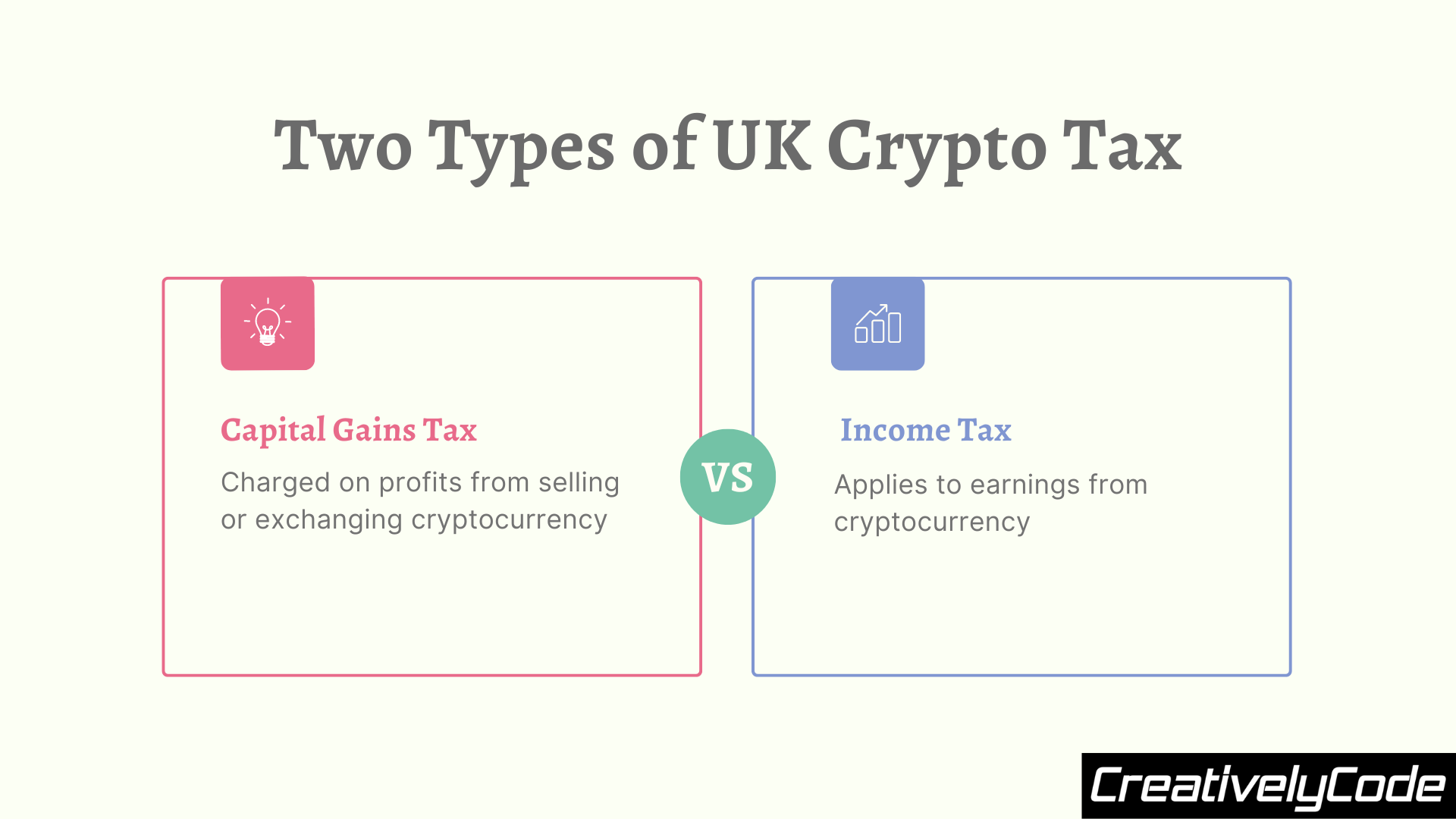
- Depending on the transaction, your crypto may be liable for either Capital Gains Tax or Crypto Income Tax.
When Do You Pay Capital Gains Tax?
- Everytime you trade crypto for crypto, including stablecoins.
- On the fee you pay for transfering crypto, see Section: Transfer Fees.
- Spending crypto on goods and services.
- Gifting crypto - unless it's to your spouse or civil partner.
- Adding/removing your crypto in a liquidity pool - if the DeFi protocol can benefit from your liquidity.
Source: HMRC: Check if you need to pay tax when you sell cryptoassets
When Do You Pay Crypto Income Tax?
HMRC considers DeFi activities with an 'income nature' as subject to Income Tax.
HMRC considers crypto transactions as income activities when:
- The return amount is predetermined rather than speculative.
- The return is paid by the borrower or DeFi platform.
- Payments are made periodically during the lending or staking period.
Practical examples which are likely considered as income:
- Earning new crypto tokens via yield farming on platforms like AAVE or Compound.
- Receiving new liquidity pool tokens, governance tokens, or reward tokens.
- Getting Paid in Crypto: Known as 'money's worth,' this is subject to National Insurance.
- Staking Rewards: Taxable.
- Mining Tokens: Tax obligations apply.
- Airdrops: Typically taxable in most instances.
How Much Is Crypto Taxed in the UK?
You pay for all transactions covered over a given tax year, the current tax year started April 6th 2024 and ends 5th April 2025.
Capital gains
Tax is only due on crypto gains, not the total proceeds, in other words - only profits are taxable.
- In the UK, you have a tax-free personal allowance. The personal allowance for the current tax year is £3000. So you only pay taxes above £3000.
- The tax rate for capital gains exceeding the £3,000 tax-free allowance is either 10% or 20%.
Once you've exceeded your allowance, you'll pay the following rate:
- If you earned less than £50,270 (total income) - you'll pay 10% on crypto gains.
- If you earned more than £50,279 (total income) - you'll pay 20% on crypto gains. (earned more as a salary or from your crypto profits?)
Sources: HMRC: Capital Gains Tax allowances HMRC: Capital Gains Tax: what you pay it on, rates and allowances
Tax from crypto income:
Crypto income is taxed like regular income and is added to your total income for the tax year.
For income, the UK uses a progressive income tax system, meaning different portions of income are taxed at different rates.
The first £12,570 earned on all income is tax free
But
Taxpayers earning more than £100,000 annually receive a reduced personal allowance.
And taxpayers earning more than £125,000 annually do not receive the £12,570 personal allowance.
The following are the UK tax rates:
| Tax Rate | Income Threshold |
|---|---|
| 0% | Up to £12,570 |
| 20% | £12,571 to £50,270 |
| 40% | £50,271 to £125,140 |
| 45% | Over £125,140 |
Sources: HMRC: Income Tax rates and Personal Allowances
Calculating Gains & Costs Using the UK Cost Basis Method
To calculate gains and losses on a crypto asset in the UK, you must employ the Cost Basis Method.
The UK Cost Basis method for crypto assets is known as the "share pooling" method.
It involves aggregating the cost of all crypto assets of the same type into a single pool. When selling or exchanging any of these assets, the cost basis is calculated by averaging the total cost of the pooled asset.
For example, if you bought 10 tokens at £10 each (£100 total)
Your cost basis is £100 (the amount you paid). Your selling price is £150. To calculate your profit, you subtract the cost basis from the selling price:
Profit = £150 - £100 = £50
There are, however, some rules that help prevent manipulation of gains and losses through rapid buy-sell actions.
These are the following:
1. Same-Day Rule:
This is when you buy and sell the same type of cryptocurrency tokens on the same day.
- All purchases are grouped into one single transaction.
- All sales are grouped into one single transaction.
Let's take the following example:
| Date & Time | Trade | Price | Quantity | Total Balance | Adjusted Cost Basis | Gain (Loss) |
|---|---|---|---|---|---|---|
| Feb 10th 10am | Buy | 500 | 1 | 1 | 500 | - |
| Feb 12th 11am | Buy | 1000 | 1 | 2 | - | - |
| Feb 12th 11am | Buy | 2000 | 1 | 3 | - | - |
| Feb 12th 11am | Sell | 3000 | 1 | 2 | 1200 | 1800 |
In this scenario, the combined buys on February 12th average a cost basis of £1,167 per unit after considering earlier transactions, leading to a £1,833 gain from the sale later that day.
After the sale on February 12th, there are still two units left in the inventory. These two units retain the average cost basis of £1,167 each, which was calculated based on the previous transactions. This cost basis will be used for calculating gains or losses when these units are sold in the future.
The same applies to fees:
| Date and Time | Trade | Price | Quantity | Fee percentage | Fee |
|---|---|---|---|---|---|
| Feb 8th 9am | Sell | 2050 | 1 | 8% | 160 |
| Feb 8th 10am | Sell | 1950 | 1 | 18% | 350 |
In this scenario, two sell transactions occur on February 8th, each with a different fee rate. Under the Same Day rule, the fees from these transactions are consolidated, resulting in an effective fee of £255 (calculated as the average of £160 and £350).
2. 30-Day Rule:
Any tokens bought and held for more than a day are subject to a rule linking future transactions of the same tokens within 30 days.
On January 1st, Flavia buys 100 units of Cryptocoin A at $10 each.
Later that day, she sells 60 units at $15 each, leaving him with 40 units.
The remaining 40 units are now subject to the 30-Day Rule.
Under the 30-day Rule, if Flavia buys or sells more of Cryptocoin A within the next 30 days, those transactions are linked to today's remaining units to calculate gains or losses.
In other words, this rule adjusts the cost basis of her remaining units by averaging the prices of all units bought and sold within that period.
If Leo does not engage in further transactions involving Cryptocoin A within that time frame, then these 40 units are added to the Section 104 Pool (discussed below).
Why British Government, why?
The point of the 30-Day Rule is to prevent investors from manipulating the timing of transactions to create tax advantages.
It stops investors from selling an asset to realize a loss for tax purposes and then quickly repurchasing the same asset.
Additionally, By linking transactions within 30 days, it ensures that gains or losses are calculated based on a more accurate reflection of the investor's activity, rather than just the initial purchase price.
3. Section 104 Pool
If no additional transactions happen within 30 days that can be linked, then these extra tokens are added to what's known as the Section 104 Pool.
Under this rule, you must calculate your gains or losses using the Average Cost Basis (ACB) method. This involves creating a pooled cost basis for all holdings of the same type of asset.
Calculate this by summing the total cost paid for the given crypto and then dividing the sum by the total number of assets in the pool.
| Date | Transaction | Crypto Amount | Price per Crypto | Total Cost (£) | Pool Quantity | Pool Cost Basis (£) | Average Cost per Crypto (£) | Gain/Loss (£) |
|---|---|---|---|---|---|---|---|---|
| Jan 1, 2023 | Buy | 50 SOL | 100 | 5,000 | 50 | 5,000 | 100 | - |
| Feb 4, 2023 | Buy | 30 SOL | 110 | 3,300 | 80 | 8,300 | 103.75 | - |
| Mar 2, 2023 | Buy | 20.5 SOL | 120 | 2,460 | 100.5 | 10,760 | 107.06 | - |
| Apr 1, 2024 | Sell | 67 SOL | 170 | 11,390 | 33.5 | 3,587.51 | 107.06 | 4,233.94 |
Felix starts his investment journey by purchasing 50 SOL at £100 each, totaling £5,000. This sets the initial average cost per SOL at £100. As the market evolves, Felix acquires an additional 30 SOL at £110 each, increasing his total investment by £3,300. With this transaction, the total cost basis of his SOL pool rises to £8,300, shifting the average cost per SOL to £103.75.
Continuing his investment strategy, Felix buys another 20.5 SOL at £120 each for £2,460, making his total pool 100.5 SOL with an accumulated cost of £10,760. This purchase adjusts the average cost per SOL slightly to £107.06.
A year later, on April 1, 2024, Felix decides to sell two-thirds of his holdings, totaling 67 SOL, when the market price has risen to £170 each. This sale generates £11,390. Calculating the cost of the sold SOL based on the average cost of £107.06, Felix incurs a cost basis of £7,173.02, resulting in a gain of £4,216.98.
Following this significant sale, Felix's SOL pool decreases to 33.5 units, but the average cost remains constant at £107.06 per SOL, reflecting the consistent valuation of his remaining assets.
To determine the tax due, Felix assesses his regular income. With an annual income of £70,000 in the 2024 financial year, he falls into the 20% Capital Gains Tax bracket. After applying his £3,000 CGT tax-free allowance for the 2024 fiscal year, his taxable gain was: £4,216.98 - £3,000 = £1,216.98
Felix's tax liability for the year 2024 is £243.40 (20% of £1,216.98)
Offsetting Tax
In the UK, you can use unlimited capital losses to offset against gains. Remember, you only pay Capital Gains Tax on profits.
- Capital losses from crypto investments can be carried forward indefinitely on your self-assessment tax return.
- Even if gains are below the tax-free threshold and you don't usually file a tax return, registering losses is advisable to maintain their future usability.
- HMRC allows a four-year window to register these losses; it's best to do so in the year they occur.
- If you don't file a self-assessment, you can still notify HMRC of your losses in writing within this four-year period.
- Unregistered losses after this period cannot be used to offset future gains.
This year, Jacob earned a £20,000 profit from selling Bitcoin. Last year, he reported a £10,000 loss to HMRC. Having not utilized his Capital Gains Tax-free allowance yet this year, Jacob can apply his previous £10,000 loss to decrease this year’s gain to £10,000. Then, by applying his £3,000 tax-free allowance for the 2024-25 fiscal year, his taxable gain is reduced to £7,000.
Maintain Accurate Records
You have an obligation to maintain accurate records.
- Calculate your capital gain or loss by subtracting the cost basis from the value of the crypto at the time you sell, swap, spend, or gift it.
- If this calculation results in a positive number, you have a capital gain and must pay Capital Gains Tax.
- If the result is negative, it's a capital loss, which is not taxable but can reduce your tax liability on other gains.
- Maintain accurate records of all transactions, including costs and disposal values, to correctly calculate and report your gains or losses.
(Source: HMRC Cryptoassets Manual: CRYPTO10400)
Transfer fees
- When you transfer your crypto, your wallet provider or crypto exchange will often charge a transfer fee.
- Paying this transfer fee in fiat currency, like pounds, is tax-free.
- In most instances, you'll pay the transfer fee in cryptocurrency, which is considered a taxable event.
- Spending crypto is seen as a disposal of an asset, requiring you to pay Capital Gains Tax on any profit.
- HMRC has specific guidance on allowable costs in crypto, which you can add to your cost basis.
- Transfer fees are not included in this list of allowable costs.
- Transfer fees cannot be added to your cost basis and may be viewed as disposals in some instances.
Johndy bought 1 ETH on an exchange for a price of £3,302.41.
The next day, he decided to move his ETH from his Binance wallet to his MetaMask wallet, and Binance charged a flat transfer fee of 0.005 ETH.
Since he was paying in ETH, this was considered a disposal of ETH. Therefore, Johndy needed to calculate his cost basis and the fair market value of his crypto at the point of disposal.
Overnight, the price of ETH moved up £3700, resulting in a higher fair market value for the disposal of 0.005 ETH (0.005×£3,700=£18.50).
Consequently Johndy has made a small capital gain of £1.81 from the disposal of 0.005 ETH.
Johndy should maintain accurate records of all his cryptocurrency disposals, including small gains, to ensure tax compliance, especially if his cumulative gains for the year approach or exceed the exempt threshold,
Is Any Crypto Tax Free?
You won't always pay tax on crypto in the UK.
Tax-free transactions include:
- Buying crypto with GBP.
- Holding crypto.
- Transferring cryptocurrency between your personal wallets.
- Donating cryptocurrency to charitable organizations.
- Gifting cryptocurrency to your spouse, which can be beneficial if your partner has not yet utilized their capital gains tax allowance for the year.
Does HMRC Track Your Crypto?
- HMRC has established a data-sharing arrangement with all UK crypto exchanges, and now have access to crypto transaction records dating back to 2014 and KYC information provided by users at UK exchanges or wallets.
- They are intensifying their efforts to monitor unreported crypto gains, particularly with the upcoming Cryptoasset Reporting Framework (CARF) regulations that facilitate information exchange across Europe.
- HMRC has also issued a press release urging voluntary disclosure of any unpaid crypto taxes, highlighting that failure to comply may result in additional fines and interest. To assist this process, a new service has been introduced for investors to declare any unpaid taxes on cryptocurrency transactions.
- The extent of backtracking HMRC can do to uncover unreported gains depends on the taxpayer's diligence: If reasonable care was taken but taxes were underpaid, disclosure and payment are required for the past four years.